EU politics – the main institutions and agencies
What are the main EU institutions, and what about the adjacent agencies and bodies that have either a supporting role or work as separate bodies with varying degrees of independence?
How do they operate together, and what are their main duties and responsibilities?
Early warning: The Council of Europe, the Council of the European Union, and the European Council are three distinct bodies!
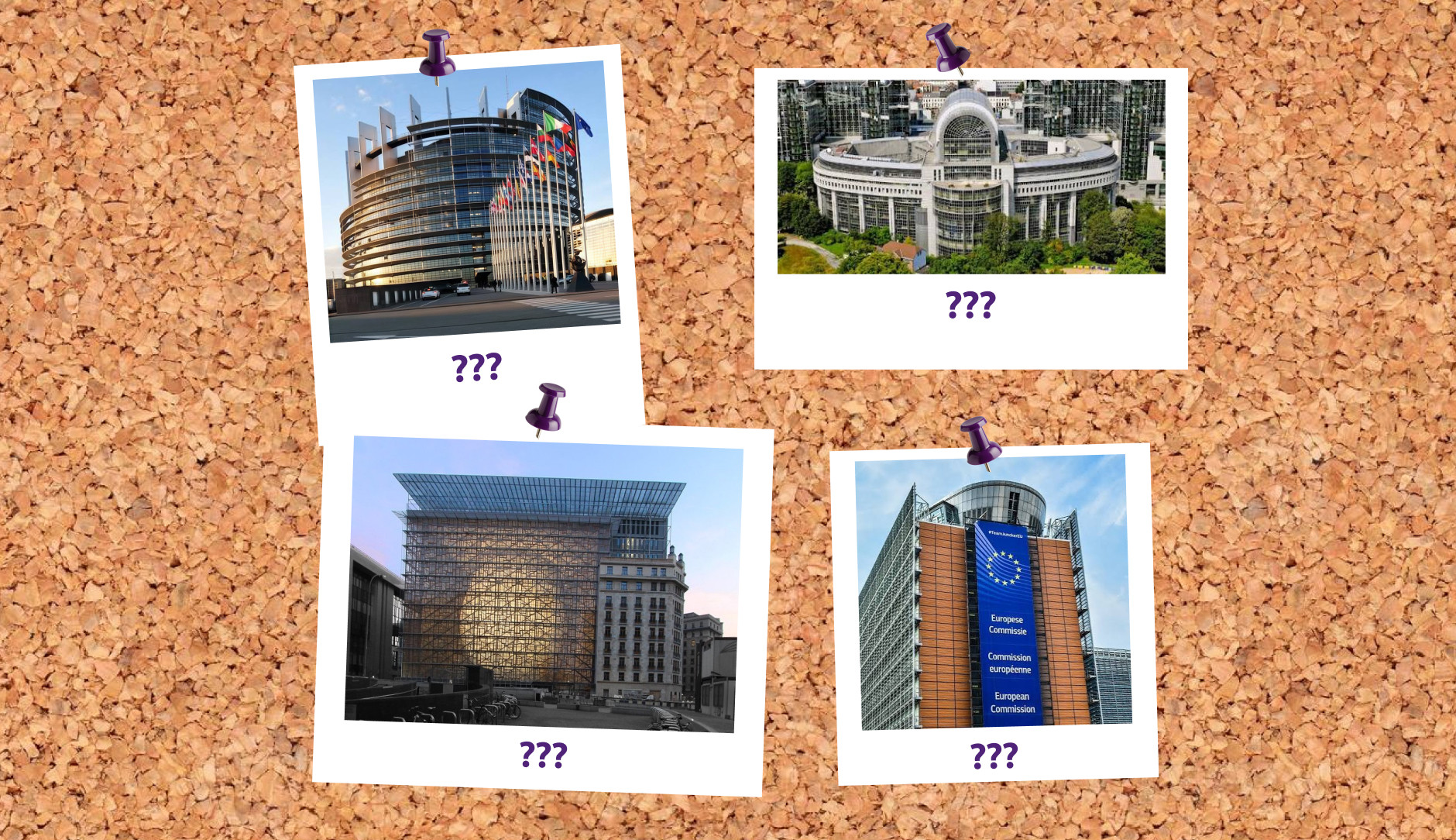
1. Where can we find the institutions and their main functions
The European cities that hold the most important institutions are Brussels, Strasbourg, Luxembourg, and Frankfurt am Main. There are seven main institutions according to Article 13 of the Treaty on European Union (TEU). Many other European capitals host either agencies, bodies, or liaison offices for better oversight on the ground. Especially for issues like the respect of human rights in member countries that are under the protection of the EU Charter of Fundamental Rights or the correct and proper usage of EU funds.
a. Brussels
 Source: https://epthinktank.eu/2016/11/03/places-in-brussels-of-symbolic-significance-for-europe/
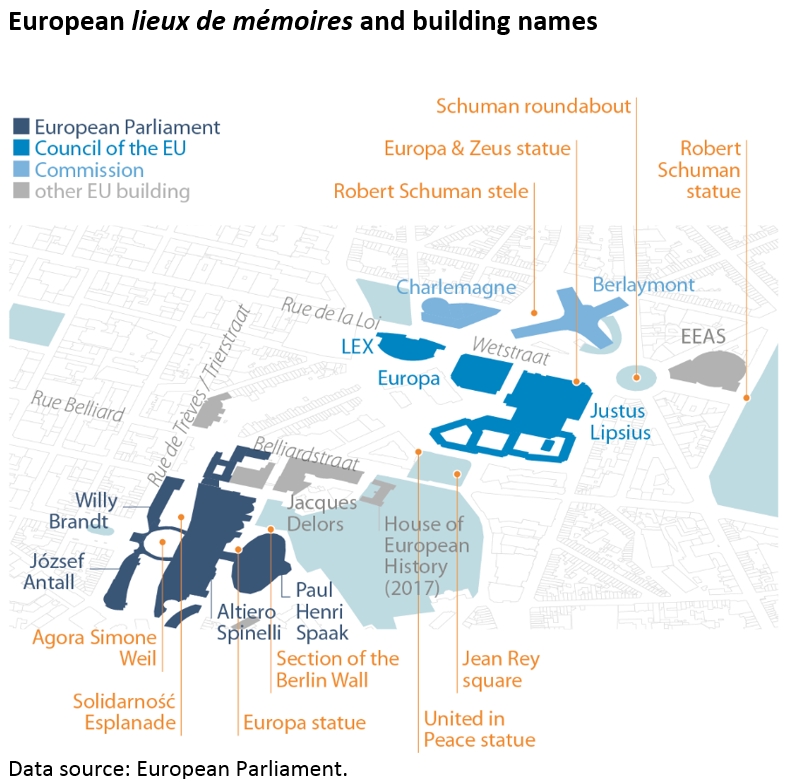
Brussels is the heart of Europe, hosting most of the EU institutions that have liaison offices around the EU. The European Parliament building in Brussels is where most of the operational and political work is done, even though it’s theoretically not the official seat of the institution. It hosts committee meetings, where amendments, (the position that the Parliament takes on proposals coming from the Commission) are drafted [1]. It is also where meetings of political groups (EPP, Renew Europe, EFA/Greens, etc.) are held and where additional voting in mini-plenary sessions are organised.
The European Commission is the main executive body, which also proposes laws that are then checked and either approved, modified, or rejected by the Parliament and the Council of the EU.
The Council of the EU (often referred to simply as The Council), formed by the ministers of each EU member state, is the second legislative body next to the Parliament. It represents national governments’ positions and priorities on different subjects, such as agriculture, foreign policy or economy.
The European Council, where the heads of the national governments gather 4 times a year. While they cannot directly pass laws, they set the political agenda of the Union. The planning is coordinated by the Council’s president during the entirety of the legislative mandates of the European Parliament and the duration of the Commission’s presidency. The Council expresses their priorities in drafted documents called “Conclusions”, which the European Commission has an obligation to follow. [2]
b. Strasbourg
 Source: https://www.coe.int/en/web/about-us/map-and-access
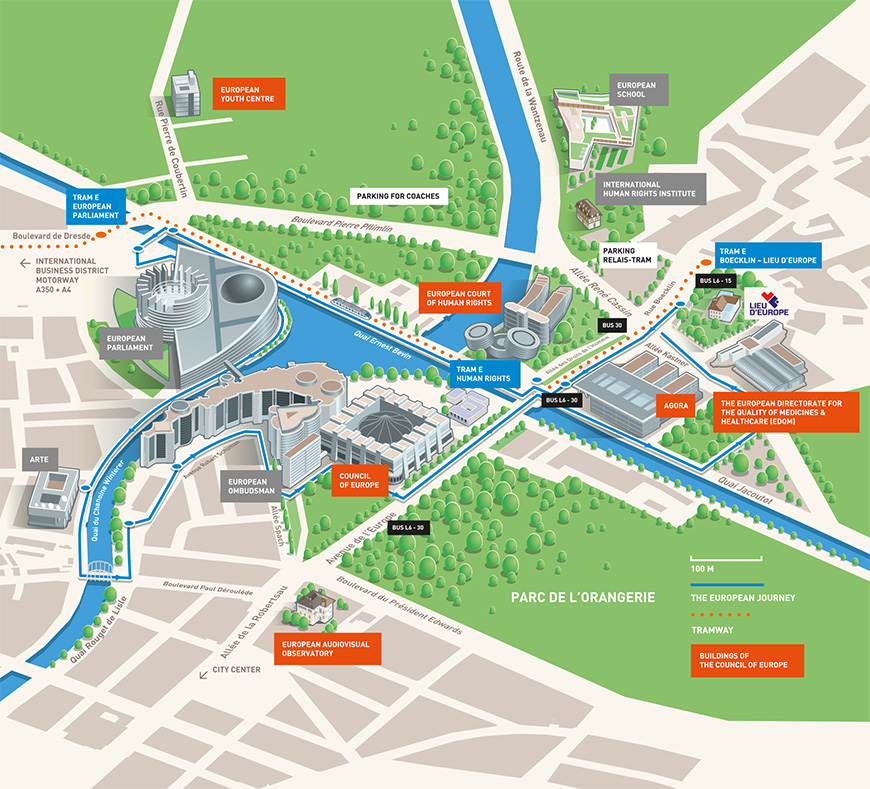
Hosts the official building of the European Parliament, where 12 plenary meetings and the State of the Union (SOTEU) take place. It also hosts the Council of Europe and its adjacent judiciary institution, the European Court of Human Rights. These two function outside of EU law, as the Court has jurisdiction over all members of the Council of Europe, which totals 46 countries from Europe and the Caucasian region.
c. Luxembourg
Most of the EU institutions and central offices in Luxembourg are concentrated in the Kirchberg plateau neighbourhood, the home of Robert Schuman, one of the EU founding fathers. Luxembourg symbolically represents EU unity, is located in between 4 different EU countries, and was one of the founders of the European Community. It is the second largest city according to the number of EU institutions based there, such as administrative offices for the European Commission and the European Parliament.
In Luxemburg the European Commission deploys units and Directorates-General that are mainly specialised in the fields of Statistics (like Eurostat), Translation and Human Ressources.
Other institutions located here are the Court of Justice of the European Union (CJEU), (which has jurisdiction in all 27 Member States) and the European Court of Auditors (ECA). It also hosts, as according to Protocol No. 6 of the Treaties of the European Union, meetings of the Council of the EU during the months of April, June, and October to split powerful decision-making between any two member states. [3]
d. Frankfurt
The European Central Bank can be found in Frankfurt am Main. Its main role is to keep inflation in check and maintain price stability in the EU. It also keeps a check on the Eurozone, as it holds monetary authority over national banks, and, through the Single Supervisory Mechanism (SSM) it supervises the largest and most significant commercial banks to ensure financial stability. [4]
Honourable mentions of committees and bodies:
Committee of the Regions
It represents local and regional authorities across the EU through its own distinct political groups that are directly connected to the ones in the Parliament. The groups are made up of local and regional elected officials such as mayors. The regional group names are confusingly similar to the Parliamentary groups: Group of the European People's Party (EPP) -> European People’s party; Party of European Socialists (PES) -> S&D; Renew Europe, carrying the same name; European Conservatives and Reformists (ECR), also carrying the same name; and The Greens and Progressives -> The Greens/EFA. Some Parliamentary groups are not represented, such as The Left.
The other institutions are obliged to consult with CoR on local policy like transport, health, education, or the environment before passing legislation.
European Investment Bank
The European Investment Bank (EIB) is the publicly owned lending institution of the European Union, serving as the world's largest multilateral financial institution. Its primary role is to borrow money on capital markets and lend it at favourable rates to projects that support EU policy goals.
European Economic and Social Committee
It serves as a bridge between the institutions and civil society, including unions of workers.
European Ombudsman
The legal watchdog of the other institutions, committees, and bodies, including over decentralised agencies, for any maladministration. See more: https://www.ombudsman.europa.eu/en/home
2. Relevant agencies
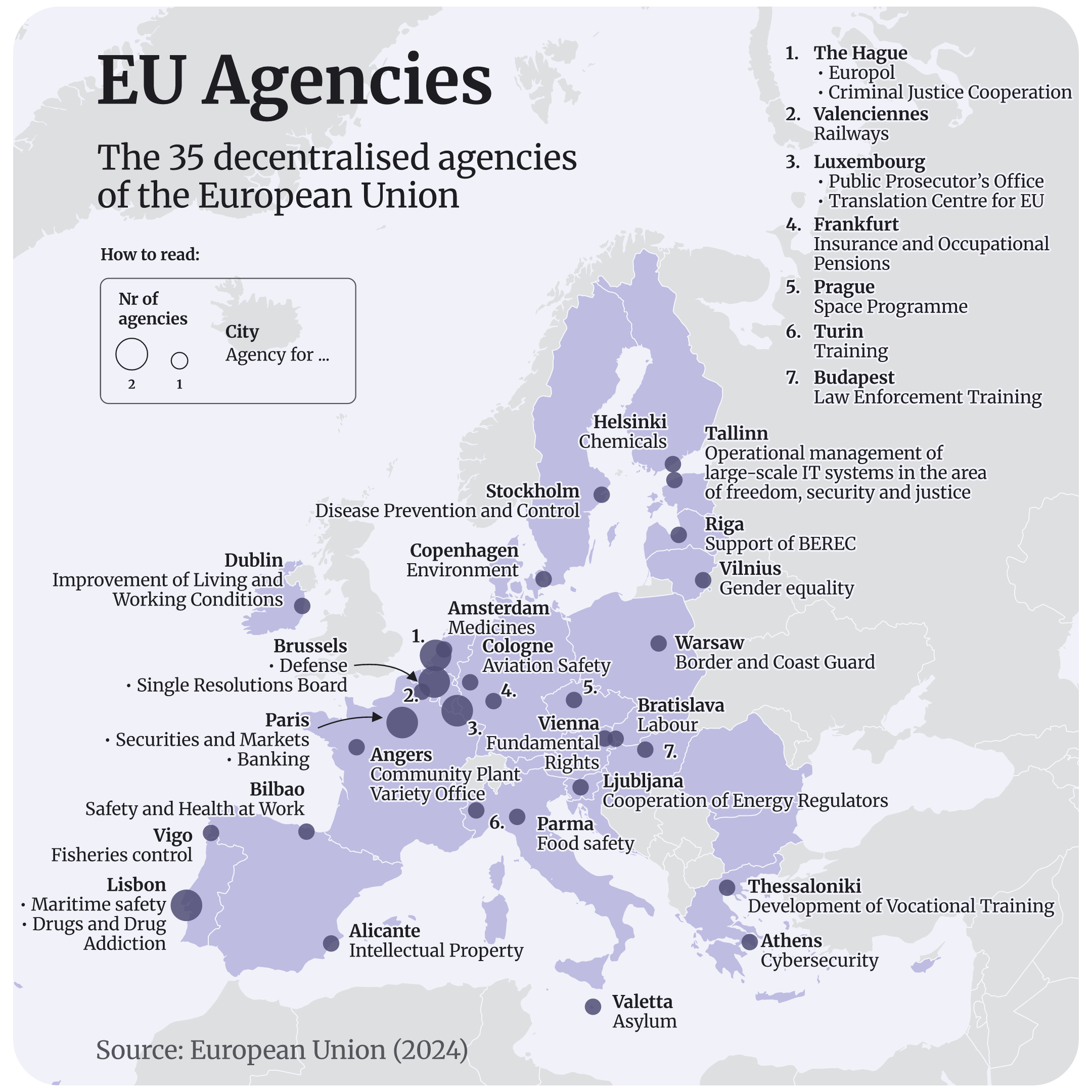
The attached map is an illustration of the most important decentralised agencies and their specific roles. Some of them don’t have their acronym attached to their domain, but they can easily be searched and identified.
 Source: European Correspondent
More of them can be found here: https://european-union.europa.eu/institutions-law-budget/institutions-and-bodies/search-all-eu-institutions-and-bodies_en
About EUROPOL
Is the law enforcement agency of the EU, with the headquarters in The Hague, the Netherlands. Even if it’s a law enforcement agency, it doesn’t have executive authority. It cannot make arrests, but it coordinates complex international operations and assists with intelligence, involving crimes like drug trafficking. It cooperates with international partners, where investigators collaborate with national authorities.
3. Influential lobbying groups
BusinessEurope, having frequent high-level meetings at the Commission
CEFIC (European Chemical Industry Council) with a big presence in Brussels
ACEA (European Automobile Manufacturers Association)
Hydrogen Europe one of the biggest lobbyists in energy, is still backed by Shell and BP (British Petroleum), promoting policy favouring fossil fuel exploitation instead of regulating usage of fossil fuel. [5]
You can explore a detailed list here, selecting EU countries: https://www.integritywatch.eu/organizations.php?s=1
More about EU lobbyists here: https://corporateeurope.org/en/2025/02/eus-lobby-league-table
And here: https://transparency.eu/who-has-been-lobbying-the-european-commission/
Sources: