Fire in the High Ferns: Belgium Must Prevent Rather Than Cure
🔥 The High Fens are burning. More than 3,000 hectares have already been affected and the fire is still not extinguished. As the risk increases, Belgium must be better prepared: strengthen our fire services, improve early detection and warning, make our forests and wetlands more resilient, and tackle climate change. Volt calls for action now.
Context
Vegetation fires are no longer a phenomenon confined to southern Europe. From Spain to Scotland, fires are becoming more frequent, more intense, and increasingly difficult to contain. Belgium is no longer immune to this reality: the major fire in the High Fens is a stark example.
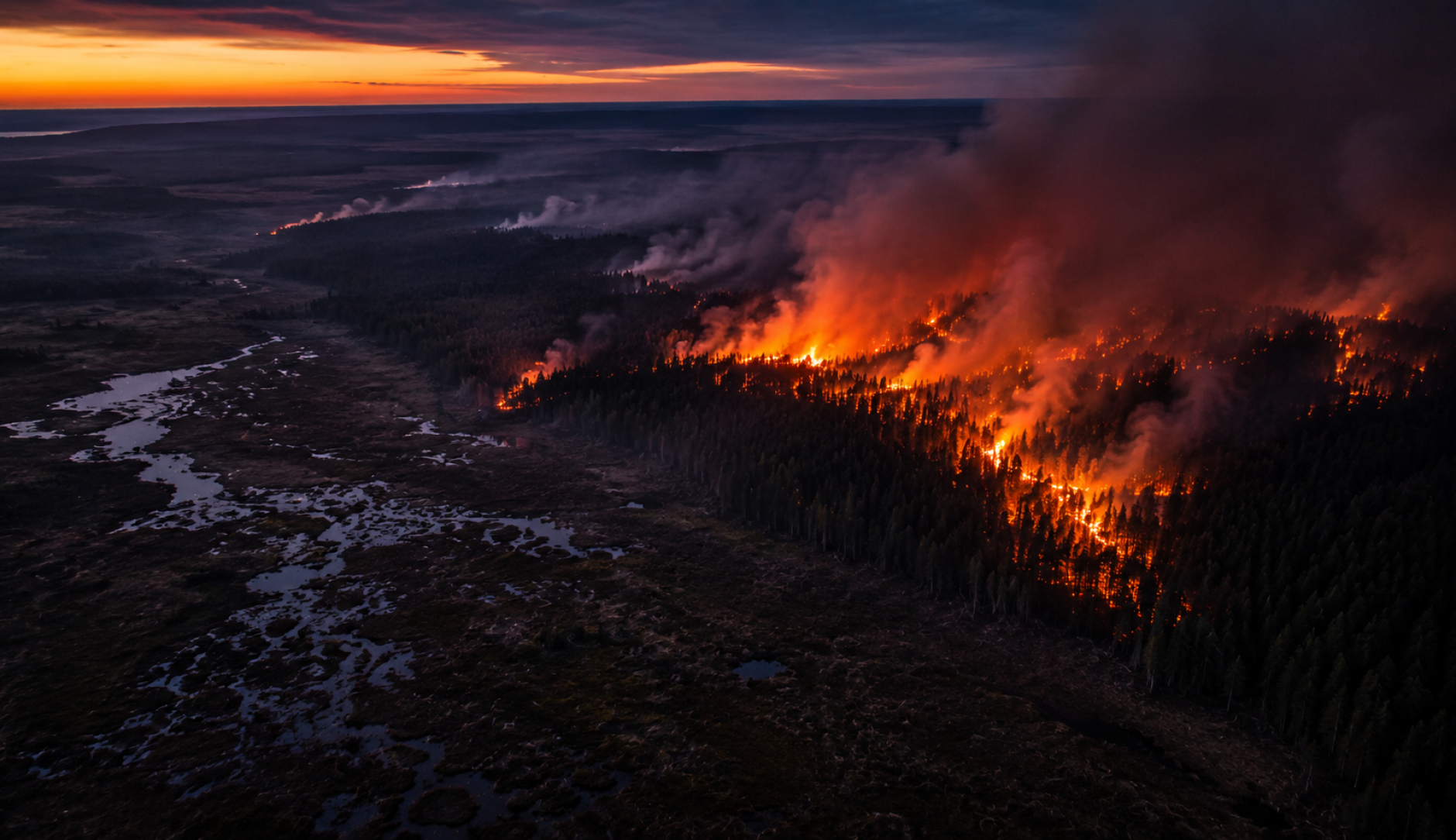
More than 3,000 hectares have been ravaged by the flames in the High Fens, and hundreds of residents have had to be evacuated [1]. The peatlands and heathlands of the High Fens are among the most valuable ecosystems in our country. Their loss would affect an entire ecosystem and essential functions such as carbon storage, biodiversity and water regulation. Even if vegetation regrows, the nutrient-poor soils will significantly slow regeneration: it will take decades, and potentially a century for some forest stands, to recover landscapes comparable to those that existed before the fire. For peatlands, formed over thousands of years, restoration will take even longer and may never fully recreate the original state [2].
It is the most severe wildfire ever recorded in Belgium [3].
Volt expresses its full solidarity with the firefighters, farmers, forest rangers, and the many volunteers mobilised to fight the flames. We also welcome and encourage European solidarity and the arrival of reinforcements from neighbouring countries.
But putting out the flames is not enough…
The priority is to tackle climate change
Scientists have been warning about climate change for decades. It is primarily driven by human activities, particularly the burning of fossil fuels. Among other effects, it contributes to longer and more intense periods of heat and drought, increasing the risk of wildfires.
Belgium is particularly vulnerable to water scarcity. It ranks 18th among the 25 countries facing extreme water stress every year [4], notably due to its high population density, pollution, extensive soil sealing and rapid water drainage. This situation increases our exposure to drought. 234 vegetation fires have already been recorded in Belgium since the beginning of this year, more than twice the number recorded during the whole of 2025 [5].
In Wallonia, 18% of Walloon households are located within 200 metres of an area at high risk of wildfires. 41% are located within 400 metres [6].
CERAC experts (Climate Change Risk Analysis Centre) also warn of a significant increase in the risk of vegetation fires over the next 10 to 15 years [7].
But preventing wildfires also means addressing their immediate causes: more than 90% of vegetation fires are linked to human activity [8]. Prevention, monitoring and spatial planning can therefore play a decisive role in reducing their frequency.
Faced with this reality, the political response should be clear: prevent and prepare.
And yet…
As the risks associated with wildfires and climate change increase, Belgium must strengthen its capacity to respond. Our fire and rescue services are already under pressure: the country has around 17,000 firefighters, while the number of volunteers is declining and emergency response zones are facing staffing shortages. Underfunding and staff shortages limit their ability to cope with crises that can now affect several regions simultaneously [9]. Beyond staffing and funding, a report by the Belgian Wildfire Network, bringing together researchers from Ghent University (UGent) and the University of Liège, highlights further weaknesses in Belgium’s capacity to address wildfires, including a lack of data, equipment and expertise, as well as the complexity of governance and the distribution of responsibilities among public authorities [10].
The recent fires in the High Fens also exposed weaknesses in our ability to monitor and communicate environmental health risks. The population was not warned quickly enough about the presence of fine particles in the smoke, despite very high PM2.5 concentrations being recorded locally [11].
At the same time, climate action remains insufficient and is still facing political pushback. In 2025, Deputy Prime Minister David Clarinval, among others, called for certain climate and environmental measures to be put “on pause” [12], while in Flanders, the government scaled back some of its climate ambitions [13]. As climate-related risks intensify, we must instead invest both in our response capacity and in prevention.
Belgium’s national aerial capacity for fighting vegetation fires remains limited. The recent orders for Chinook and H145M helicopters [14] represent a welcome strengthening of the Defence Forces’ capabilities and can also provide valuable support in the event of a major wildfire. However, they must form part of a broader strategy, combining aerial capabilities, ground resources, prevention, early detection and cross-border cooperation.
This is why Volt calls for:
Jointly procure firefighting helicopters with Luxembourg and the Netherlands;
Assess the use of Belgian A400M aircraft as a complementary capability for aerial water or fire-retardant drops;
Strengthening early detection and warning systems, in order to intervene before fires gain momentum and ensure that the population is promptly warned when smoke poses a health risk;
Developing a national and interregional database on vegetation fires, recording fire starts, burned areas, weather conditions, causes, interventions and damage, in order to improve prevention, risk assessment and resource planning;
Establishing a federal coordination mechanism for vegetation fires and strengthening cooperation between the federal government, the Regions and emergency services, in order to coordinate response efforts and rapidly mobilise additional resources in the event of a major fire;
Strengthening the prevention of fire outbreaks during periods of high risk, notably through targeted information campaigns, temporary restrictions on certain high-risk activities and better enforcement of existing rules;
Integrating vegetation-fire risk into spatial planning, particularly in areas where homes or vulnerable infrastructure are located next to forests, heathlands or other fire-prone natural areas;
Adapting the management of our forests, land and water to climate risks, notably by diversifying tree species and reducing the continuity of flammable vegetation, with particular attention to fire-prone conifer monocultures;
Creating strategic measures to break up the continuity of combustible vegetation, adapted to different ecosystems and designed in consultation with nature managers, while restoring wetlands to strengthen the resilience of our territories;
Compensating farmers mobilised in the High Fens for the hours worked and any material damage incurred;
Strengthening staffing, specialised training and equipment for firefighters, the Civil Protection and forest rangers;
And above all, gradually phasing out our dependence on fossil fuels, in order to limit the worsening of climate change.
Tomorrow’s wildfires are not inevitable. But the risk of more frequent and more devastating vegetation fires will increase as climate change intensifies.
Let’s not wait for the next disaster to act.
Sources:
[1] https://www.rtbf.be/article/direct-incendie-dans-les-fagnes-habitants-evacues-2700-hectares-partis-en-fumee-les-pompiers-continuent-a-lutter-contre-le-feu-11770992
[7] https://www.cerac.be/fr/news/2026-07-la-frequence-des-feux-de-vegetation-ne-cesse-daugmenter
[8] https://environnement.wallonie.be/feux
[9] https://www.rtl.be/actu/lenquete/cest-une-reelle-catastrophe-les-pompiers-belges-debordes-et-trop-peu-nombreux/2026-06-07/article/790949 & https://www.lesoir.be/765408/article/2026-08-17/il-faut-agir-rapidement-le-president-des-pompiers-denonce-le-sous-financement
[13] https://www.rtbf.be/article/le-nouveau-gouvernement-flamand-freine-ses-ambitions-climatiques-11442379, https://www.demorgen.be/nieuws/n-va-pleit-voor-klimaatpauze-onverantwoord-zegt-klimaatwetenschapper~bc9efce2/?referrer=https%3A%2F%2Fwww.google.com%2F & https://daardaar.be/rubriques/environnement/rechauffement-climatique-labsence-dalarmisme-de-la-n-va-nuit-aux-plus-vulnerables/